To read
Fashion
The Ego’s Narrow Catwalk
Peggy Papada*
Comme des Garçons is a Japanese fashion label, founded in 1969 and based in Paris. Following her studies in literature and art history, its founder, Rei Kawakubo, joined a textile company’s advertising department, yet quickly realised that she could not source costumes that would accurately represent her ideas or match her style. She proceeded to design her own costumes without any formal training in fashion. She moved on to become a freelance stylist and eventually, in 1969 she began to provide stores in Tokyo with her own designs. The brand’s name Comme des Garçons, was inspired from a line in Françoise Hardy’s song “Tous les garçons et les filles”. Translated as “Like boys” it points to a departure from the existing gender norms and conventional standards of beauty with a proposal of subversive garment shapes that defy traditional tailoring and common trends, and an altogether new relationship between body and clothing.
Thus, the brand’s clothes ran counter to the overexposure of the female body reported to be prevalent at the time of its inception, a signature style that continues to persist throughout the decades, as the body in Rei Kawakubo’s designs, is usually enveloped and hidden behind voluminous shapes. When the label made its debut in Paris in 1981, the French Press was not very welcoming due to its use of black, “distressed” fabric and punk counterculture that broke away from the aesthetic standards of haute couture. It was unlike anything else in fashion at the time. Yet the brand’s style is defined precisely by its originality and anti-fashion, and its designer has been hailed as a leading figure of the avant-garde so much so that in 2017 the Metropolitan Museum of Art in New York, hosted an art exhibition about her work and designs for Comme.
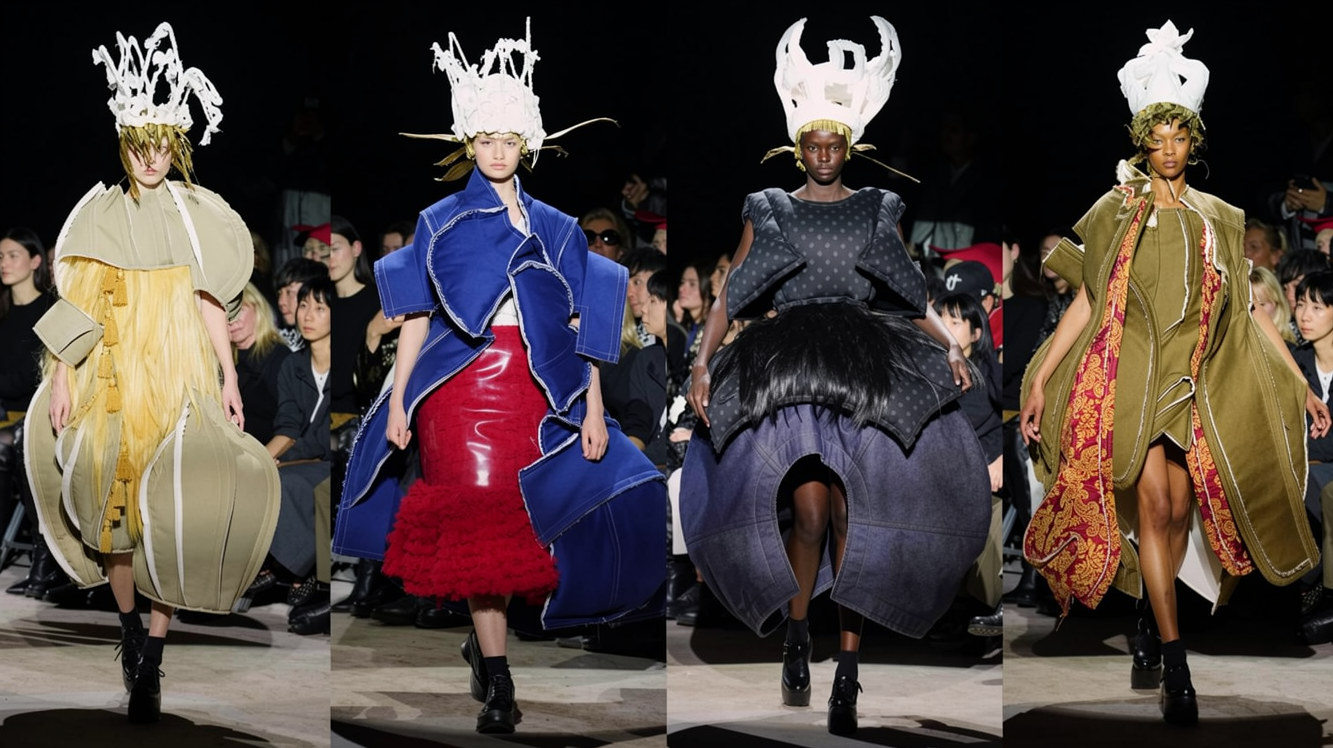
Kawakubo’s desire to “start from zero” and “to do things that have never been done before”[1] is evident from her collections over the years. By browsing through them one can see why the brand has come to embody originality and innovation in the world. One such collection is the latest Spring 2027 ready-to-wear, entitled “We’ll Never Be Royals”, presented on 3 October 2026, at Paris Fashion Week and explained by Kawakubo herself in one line: “When royal life and everyday life become one”. Her overpowering, sculptured shapes are made of humble denim, thus juxtaposing high-society status with everyday utility. The looks on the catwalk are completed with makeshift fabric crowns, a constant element until the conclusion of the show, which is when they are replaced by foil dome shapes[2]. Fashion critics interpreted this self-coronation as the effect of social media, through which everyone curates and broadcasts themselves, their image. Everyone can live their individual myth.
It is thus not only in psychoanalysis that the rise of the ego and its consequences have become apparent. Whatever one’s views on royalty, it evokes hierarchy, customs, tradition, which is what contemporary individualism calls into question. This is also what the collection invites us to reconsider through the dismantling of semblants it proposes in the name of an egalitarian ideal (When royal life and everyday life become one). Defined by the formula “I am what I say”,[3] the self-determined, autonomous individual, crown on head, casts aside history and tradition. He is able to say what he believes himself to be and impose it on others, often without an iota of doubt or shame. Gone is the courtesy of old times – the models of Comme des Garçons, ensnared in their bulky attires, have to squeeze past one another on the narrow catwalk. There is something deeply unsettling about this staging, in which no exchange takes place. And just as Kawakubo’s inflated silhouettes seem on the verge of bursting, so too is the inflated ego at risk of bursting, its self-made crown reduced to a foil dome.
* Psychoanalyst member of WAP and NLS. Practices psychoanalysis in London
[1] Interview with Rei Kawakubo, by Eleanor Gibson, 9 May 2019: https://www.dezeen.com/2019/05/09/rei-kawakubo-comme-des-garcons-interview/
[2] The 2027SS Comme des Garçons collection is available here (video): https://www.comme-des-garcons.com/cdg-video.html, and here (images): https://www.goldfoil.eu/runway/comme-des-garons-spring-2027
[3] Miller, J.-A., Intervention during the « Question d’École », École de la Cause freudienne, Paris, 22 January 2022, unpublished.
Comme des Garçons is a Japanese fashion label, founded in 1969 and based in Paris. Following her studies in literature and art history, its founder, Rei Kawakubo, joined a textile company’s advertising department, yet quickly realised that she could not source costumes that would accurately represent her ideas or match her style. She proceeded to design her own costumes without any formal training in fashion. She moved on to become a freelance stylist and eventually, in 1969 she began to provide stores in Tokyo with her own designs. The brand’s name Comme des Garçons, was inspired from a line in Françoise Hardy’s song “Tous les garçons et les filles”. Translated as “Like boys” it points to a departure from the existing gender norms and conventional standards of beauty with a proposal of subversive garment shapes that defy traditional tailoring and common trends, and an altogether new relationship between body and clothing.
Thus, the brand’s clothes ran counter to the overexposure of the female body reported to be prevalent at the time of its inception, a signature style that continues to persist throughout the decades, as the body in Rei Kawakubo’s designs, is usually enveloped and hidden behind voluminous shapes. When the label made its debut in Paris in 1981, the French Press was not very welcoming due to its use of black, “distressed” fabric and punk counterculture that broke away from the aesthetic standards of haute couture. It was unlike anything else in fashion at the time. Yet the brand’s style is defined precisely by its originality and anti-fashion, and its designer has been hailed as a leading figure of the avant-garde so much so that in 2017 the Metropolitan Museum of Art in New York, hosted an art exhibition about her work and designs for Comme.
Kawakubo’s desire to “start from zero” and “to do things that have never been done before”[1] is evident from her collections over the years. By browsing through them one can see why the brand has come to embody originality and innovation in the world. One such collection is the latest Spring 2027 ready-to-wear, entitled “We’ll Never Be Royals”, presented on 3 October 2026, at Paris Fashion Week and explained by Kawakubo herself in one line: “When royal life and everyday life become one”. Her overpowering, sculptured shapes are made of humble denim, thus juxtaposing high-society status with everyday utility. The looks on the catwalk are completed with makeshift fabric crowns, a constant element until the conclusion of the show, which is when they are replaced by foil dome shapes[2]. Fashion critics interpreted this self-coronation as the effect of social media, through which everyone curates and broadcasts themselves, their image. Everyone can live their individual myth.
It is thus not only in psychoanalysis that the rise of the ego and its consequences have become apparent. Whatever one’s views on royalty, it evokes hierarchy, customs, tradition, which is what contemporary individualism calls into question. This is also what the collection invites us to reconsider through the dismantling of semblants it proposes in the name of an egalitarian ideal (When royal life and everyday life become one). Defined by the formula “I am what I say”,[3] the self-determined, autonomous individual, crown on head, casts aside history and tradition. He is able to say what he believes himself to be and impose it on others, often without an iota of doubt or shame. Gone is the courtesy of old times – the models of Comme des Garçons, ensnared in their bulky attires, have to squeeze past one another on the narrow catwalk. There is something deeply unsettling about this staging, in which no exchange takes place. And just as Kawakubo’s inflated silhouettes seem on the verge of bursting, so too is the inflated ego at risk of bursting, its self-made crown reduced to a foil dome.
* Psychoanalyst member of WAP and NLS. Practices psychoanalysis in London
[1] Interview with Rei Kawakubo, by Eleanor Gibson, 9 May 2019: https://www.dezeen.com/2019/05/09/rei-kawakubo-comme-des-garcons-interview/
[2] The 2027SS Comme des Garçons collection is available here (video): https://www.comme-des-garcons.com/cdg-video.html, and here (images): https://www.goldfoil.eu/runway/comme-des-garons-spring-2027
[3] Miller, J.-A., Intervention during the « Question d’École », École de la Cause freudienne, Paris, 22 January 2022, unpublished.