
To listen
Music
The Exuberance and Uniqueness on Pabllo Vittar
Niraldo De Oliveira*
How does one transform one’s own existence into a force capable of expanding the limits of what a society considers mainstream? Pabllo Vittar’s trajectory is not limited to the rise of a Brazilian pop singer to the international market. It also concerns the way in which the presence of someone, at first considered inappropriate, can occupy the spotlight, transform the public’s gaze and create possibilities for other people to exist.
Born in the state of Maranhão, in the northeastern region of Brazil, Pabllo began her musical career in 2015 with the successful album “Open Bar.” She quickly conquered an audience beyond borders. Singer and drag queen, she has become one of the most internationally recognized artists in this field by bringing her music to major festivals and collaborating with artists from different countries. Her path, however, cannot be understood only by numbers, awards, or the popularity of her songs and social media. There is something in this trajectory that touches a broader question: who has the right to appear, be heard, and occupy a place of recognition in society?
Pabllo built her career in an environment invaded by violence against LGBTQIA+ people, in a country marked by deep inequalities and discrimination – it is worth remembering that Brazil is one of the countries that has the highest violence rates against transgender people and cross-dressers in the world. Pabllo’s public exposure brought recognition, but also attacks, criticism and attempts to reduce her artistic presence to provocation. Her success did not eliminate the hostility against her. Rather, to ignore the contradiction an artist can achieve enormous popularity and, concomitantly, continue to be the target of intolerance.
Therefore, it is necessary to go beyond the well-known resilience narrative. It is not simply someone who faced obstacles and overcame them. Pabllo made her own artistic creation a way to expand the boundaries of what can be seen, heard and recognized as legitimate. The drag queen is not just pretending to play a character: she raises questions through her voice, clothes, gestures, dance and makeup that shake the pillars with which we usually organize the world.
Her voice deserves special attention. The criticism towards Pabllo’s voice, often considered too high-pitched or inappropriate gender standards, reveals something that goes beyond musical evaluation. What is expected from a male voice? What is considered natural in a female voice? Why do certain vocal characteristics cause discomfort when they do not correspond to established conventions? The voice is not only an instrument for singing, it also voices the conflict between singularity and the norms that frame it.
Pabllo does not need to erase her intrinsic difference to conquer her public. Her artistic power does not depend upon the need to identify herself with those who previously occupied the spotlight. On the contrary, it is the affirmation of a singular presence that allows her to build her place. The difference is no longer what could justify exclusion, and it begins to produce the invention of a language.
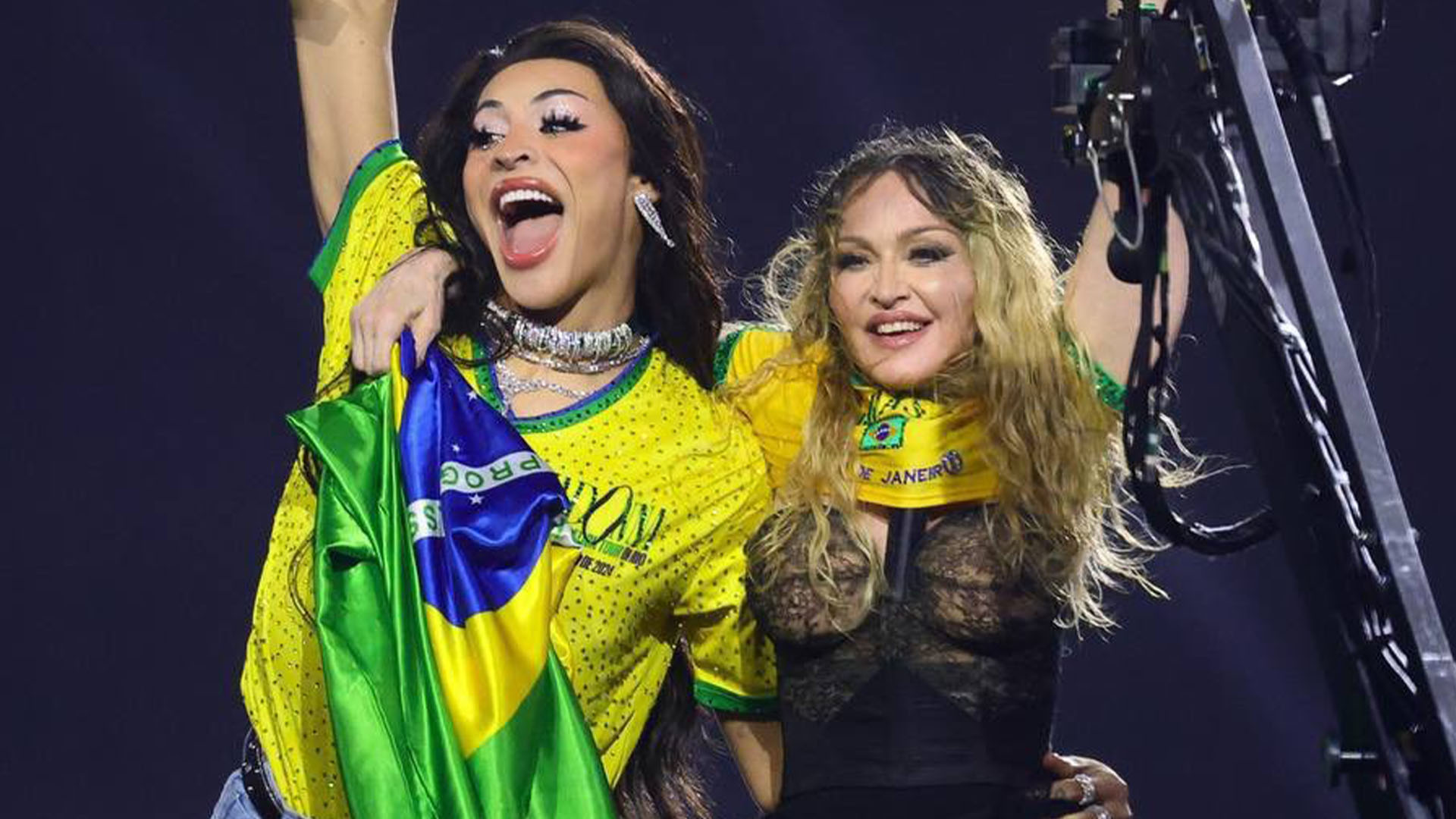
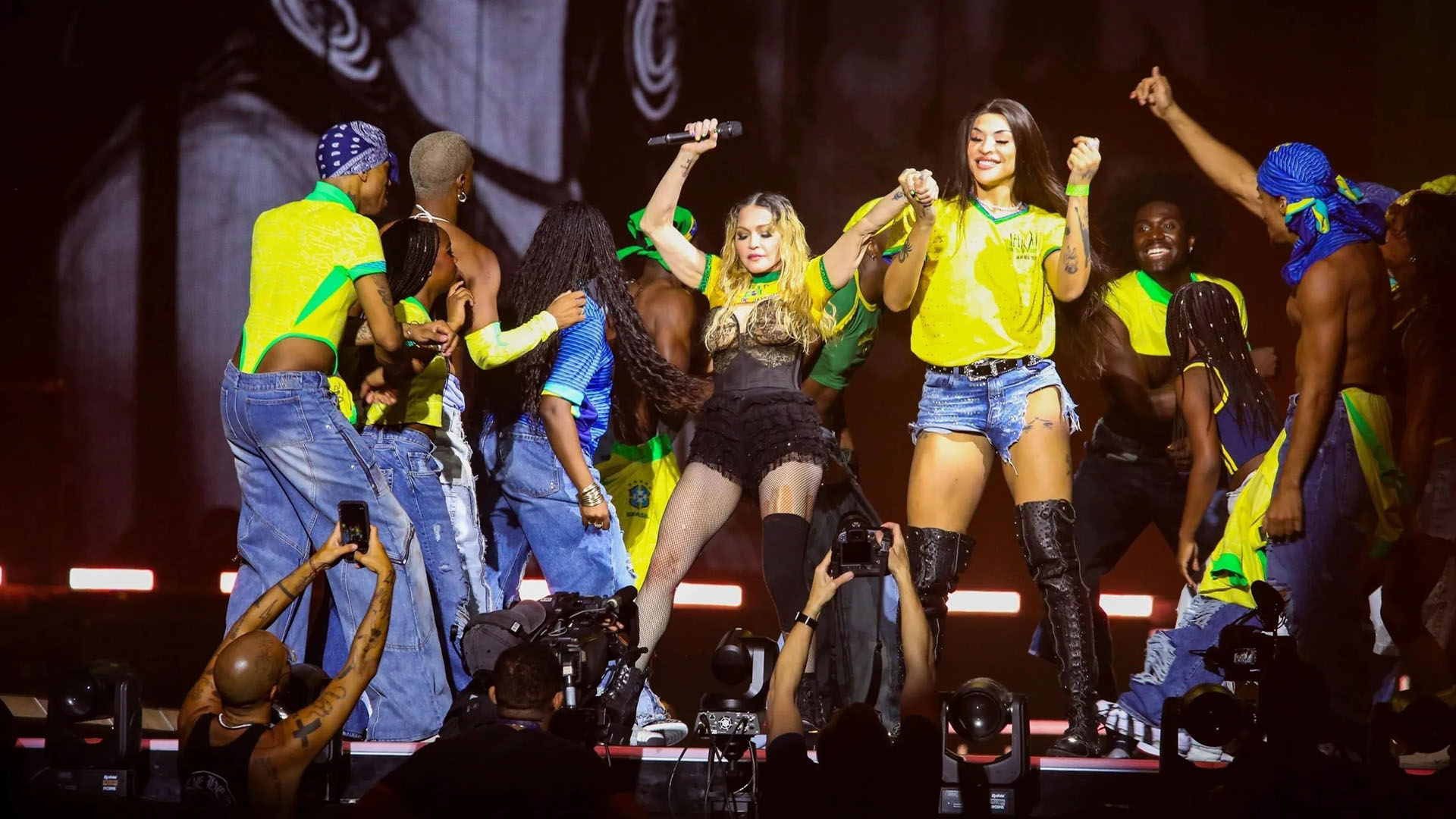
An expressive image of her trajectory was her performance in Madonna’s concert, on May 4th, 2024, in Copacabana, Rio de Janeiro. In front of an estimad 1.6 million person crowd, Pabllo shared the stage with one of the biggest stars in the world of pop music. During the performance of the song “Music”, the two danced among Brazilian percussionists and held Brazilian flags, dressed in Brazilian soccer jerseys – symbols that were seemingly used by the far-right Bolsonaro’s supporters. Famous names of Brazilian artists were also projected onto numerous screens along the beach in a show of international reach.
Pabllo’s presence on the stage had a particular strength: it was not necessary to give up her singularity to get there. On the contrary, it was precisely the exuberance of her artistic presence that allowed her to occupy that space. What was for a long time treated as deviation or mockery was now being performed in front of millions of spectators. This does not mean that visibility eliminates prejudice or dissolves inequalities. It means that the limits of what can be publicly recognized no longer remain the same.
The joy that emanates from her music and performances also deserves to be taken seriously. The dance floor can be a space for celebration, but also for freedom. There, bodies often constrained to justify their existence can experience other forms of relationship within themselves and with others. Joy, in this context, is not the opposite of resistance. It can be one of its most powerful forms.
Jacques Lacan created the term speaking-being to highlight that we are beings constituted by language, but also marked by a body that experiences satisfactions, discomforts, and singular modes of jouissance. We are not only defined by discourses that pierce us, by identities we embrace, or by contemporary classifications imposed by mainstream culture. There is always something that goes beyond the words we use to try to define who we are.
Éric Laurent introduces the political speaking-being[1], which carries in itself the ability to confront the segregation and biopolitics so striking in our times. By her voice, her body and her art, she builds a presence that is impossible to ignore. Pabllo Vittar shows that singularity can produce collective effects. Perhaps this is one of the strengths of art: not offering a definitive solution to contemporary conflicts but allowing other ways to inhabit the world. When a body transforms its own difference into a public presence, it not only demands a place in the existing order, but it can also question this order as natural, necessary and unchangeable.
* Psychoanalyst member of WAP and EBP. Practices psychoanalysis in São Paulo
[1] LAURENT, É. “O avesso da biopolítica. Uma escrita para o gozo.” Rio de Janeiro: Contra Capa, 2016.
How does one transform one’s own existence into a force capable of expanding the limits of what a society considers mainstream? Pabllo Vittar’s trajectory is not limited to the rise of a Brazilian pop singer to the international market. It also concerns the way in which the presence of someone, at first considered inappropriate, can occupy the spotlight, transform the public’s gaze and create possibilities for other people to exist.
Born in the state of Maranhão, in the northeastern region of Brazil, Pabllo began her musical career in 2015 with the successful album “Open Bar.” She quickly conquered an audience beyond borders. Singer and drag queen, she has become one of the most internationally recognized artists in this field by bringing her music to major festivals and collaborating with artists from different countries. Her path, however, cannot be understood only by numbers, awards, or the popularity of her songs and social media. There is something in this trajectory that touches a broader question: who has the right to appear, be heard, and occupy a place of recognition in society?
Pabllo built her career in an environment invaded by violence against LGBTQIA+ people, in a country marked by deep inequalities and discrimination – it is worth remembering that Brazil is one of the countries that has the highest violence rates against transgender people and cross-dressers in the world. Pabllo’s public exposure brought recognition, but also attacks, criticism and attempts to reduce her artistic presence to provocation. Her success did not eliminate the hostility against her. Rather, to ignore the contradiction an artist can achieve enormous popularity and, concomitantly, continue to be the target of intolerance.
Therefore, it is necessary to go beyond the well-known resilience narrative. It is not simply someone who faced obstacles and overcame them. Pabllo made her own artistic creation a way to expand the boundaries of what can be seen, heard and recognized as legitimate. The drag queen is not just pretending to play a character: she raises questions through her voice, clothes, gestures, dance and makeup that shake the pillars with which we usually organize the world.
Her voice deserves special attention. The criticism towards Pabllo’s voice, often considered too high-pitched or inappropriate gender standards, reveals something that goes beyond musical evaluation. What is expected from a male voice? What is considered natural in a female voice? Why do certain vocal characteristics cause discomfort when they do not correspond to established conventions? The voice is not only an instrument for singing, it also voices the conflict between singularity and the norms that frame it.
Pabllo does not need to erase her intrinsic difference to conquer her public. Her artistic power does not depend upon the need to identify herself with those who previously occupied the spotlight. On the contrary, it is the affirmation of a singular presence that allows her to build her place. The difference is no longer what could justify exclusion, and it begins to produce the invention of a language.
An expressive image of her trajectory was her performance in Madonna’s concert, on May 4th, 2024, in Copacabana, Rio de Janeiro. In front of an estimad 1.6 million person crowd, Pabllo shared the stage with one of the biggest stars in the world of pop music. During the performance of the song “Music”, the two danced among Brazilian percussionists and held Brazilian flags, dressed in Brazilian soccer jerseys – symbols that were seemingly used by the far-right Bolsonaro’s supporters. Famous names of Brazilian artists were also projected onto numerous screens along the beach in a show of international reach.
Pabllo’s presence on the stage had a particular strength: it was not necessary to give up her singularity to get there. On the contrary, it was precisely the exuberance of her artistic presence that allowed her to occupy that space. What was for a long time treated as deviation or mockery was now being performed in front of millions of spectators. This does not mean that visibility eliminates prejudice or dissolves inequalities. It means that the limits of what can be publicly recognized no longer remain the same.
The joy that emanates from her music and performances also deserves to be taken seriously. The dance floor can be a space for celebration, but also for freedom. There, bodies often constrained to justify their existence can experience other forms of relationship within themselves and with others. Joy, in this context, is not the opposite of resistance. It can be one of its most powerful forms.
Jacques Lacan created the term speaking-being to highlight that we are beings constituted by language, but also marked by a body that experiences satisfactions, discomforts, and singular modes of jouissance. We are not only defined by discourses that pierce us, by identities we embrace, or by contemporary classifications imposed by mainstream culture. There is always something that goes beyond the words we use to try to define who we are.
Éric Laurent introduces the political speaking-being[1], which carries in itself the ability to confront the segregation and biopolitics so striking in our times. By her voice, her body and her art, she builds a presence that is impossible to ignore. Pabllo Vittar shows that singularity can produce collective effects. Perhaps this is one of the strengths of art: not offering a definitive solution to contemporary conflicts but allowing other ways to inhabit the world. When a body transforms its own difference into a public presence, it not only demands a place in the existing order, but it can also question this order as natural, necessary and unchangeable.
* Psychoanalyst member of WAP and EBP. Practices psychoanalysis in São Paulo
[1] LAURENT, É. “O avesso da biopolítica. Uma escrita para o gozo.” Rio de Janeiro: Contra Capa, 2016.
READ NEXT
To listen
Freud and Lacan in the World
Interview with Daniela Finzi by Markus Zöchmeister